














12 Dec
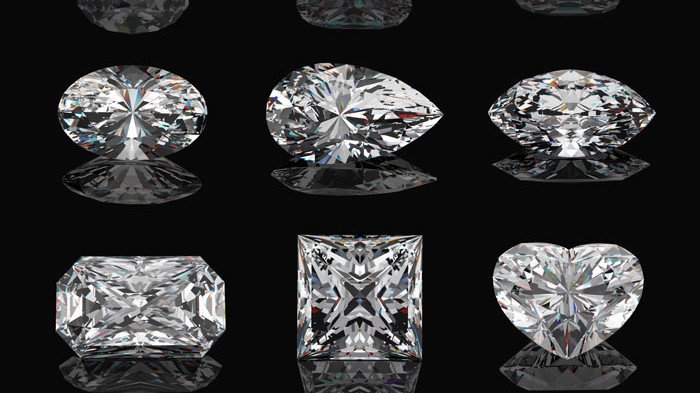
We have previously introduced three of the diamond 4Cs: Carat weight, Color, and Clarity. Today, we will walk you through the final and equally important C — Cut. Among all diamond grading factors, Cut is often the most confusing for consumers. On official GIA diamond certificates, Color, Clarity, and Carat all feature clear and detailed classification standards. However, the Cut section only displays specific diamond angles, proportions, and grading results without further explanatory descriptions.
The quality of a diamond’s cut follows strict scientific data standards. In simple terms, a well-cut diamond allows light to enter from the top surface, reflect fully inside the stone, and radiate back out from the top to deliver optimal brilliance. Diamonds produce three unique light effects: Brilliance, Fire, and Scintillation.
Brilliance refers to the bright white light reflected by a diamond, which creates the classic sparkling white shine people perceive.
Fire, also known as dispersion, occurs when diamond facets act like prisms, breaking down white light into a vivid spectrum of red, orange, yellow, green, blue, indigo, and violet rainbow hues.
Scintillation describes the dynamic sparkling visual effect produced when light bounces across different diamond facets — the iconic “bling-bling” shimmer that makes diamonds eye-catching when moved.
鑽石有 3 種光彩,即是亮光 ( Brilliance )、火光 ( Fire ) 與閃光 ( Scintillation )。所謂的亮光即是鑽石反射出來白色的光,一般人看到白色的光便會說好亮、好亮;而火光則是鑽石的刻面像三菱鏡般,將白色的光分成紅、橙、黃、綠、藍、靛,紫七彩的光芒,所以火光又稱為彩虹光或色散 ( Dispersion );而所謂的閃光則是光線在鑽石不同刻面跳躍展現出來的視覺效果,也就是女孩子常講的 bling – bling 的感覺。
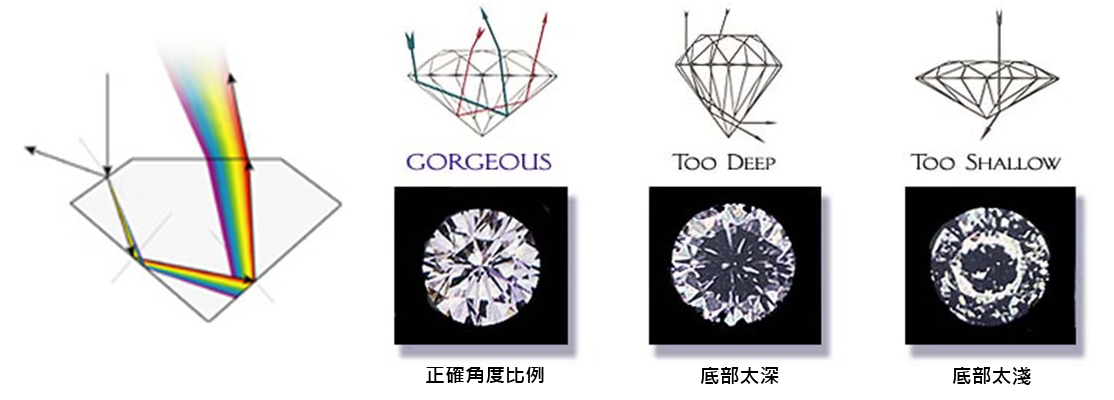
Diamonds have fixed optical and physical properties: a refractive index of 2.42, a dispersion rate of 0.04, and a critical angle of 24.5 degrees. Taking the internationally popular round brilliant cut as the standard, a complete diamond features 57 or 58 facets. Precise arrangement of facet angles and proportions enables full internal light reflection, ensuring maximum light output from the diamond’s top surface.
From a side view, a loose diamond consists of three main parts: the crown, girdle, and pavilion. Based on optical principles, an overly high or low crown, or an excessively deep or shallow pavilion will cause light leakage. Light entering the diamond cannot reflect completely, resulting in a dull appearance.
A well-cut diamond adopts precise facet proportions and angles to deliver perfect brilliance, fire, and scintillation through full light reflection. Top-tier cut diamonds not only feature accurate proportions but also meet strict standards for facet symmetry and polishing finish.
Most consumers only understand diamonds are priced by carat weight. For this reason, most diamond cutting factories prioritize retaining the maximum weight of rough diamonds. They often slightly raise the crown, deepen the pavilion, or thicken the girdle to preserve carat weight, rather than pursuing ideal and perfect cut proportions.
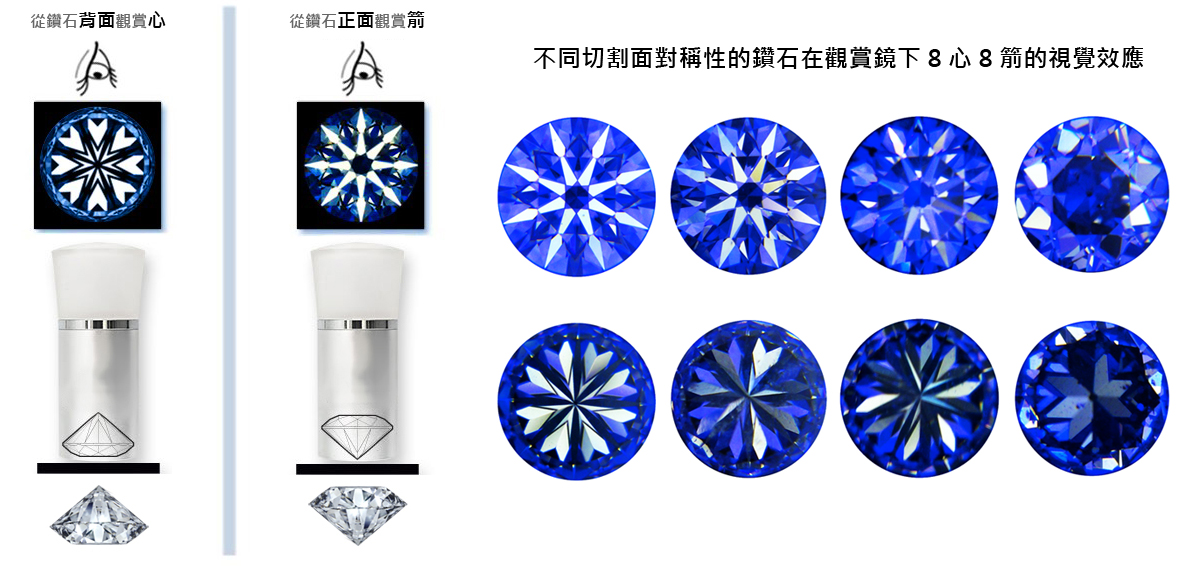
A common misconception among consumers is believing that diamonds with the “8 Hearts and 8 Arrows” pattern guarantee a premium cut quality. In fact, the 8 Hearts and 8 Arrows effect only proves excellent facet symmetry. When a diamond’s upper and lower facets align perfectly, eight arrow shapes appear on the top and eight heart shapes on the bottom when viewed through a professional scope.
Nevertheless, perfect symmetry does not equal accurate angles and ideal proportions. To illustrate with a simple analogy: a perfectly symmetrical cartoon character may have disproportionate body features, and a symmetrical model with an extremely long upper body and short legs still looks unbalanced. Similarly, symmetrical diamond facets do not guarantee scientifically correct cut proportions.
Most jewelry stores and counters deliberately promote the 8 Hearts and 8 Arrows effect as a selling point, as it lacks strict unified grading standards. Most ordinary consumers cannot identify professional cut quality and easily mistake this visual effect for a high-grade cut. In fact, a wider table creates thinner arrow patterns, while a narrower table produces thicker arrows. Additionally, clear 8 hearts on the bottom do not always correspond to complete 8 arrows on the top, and vice versa.
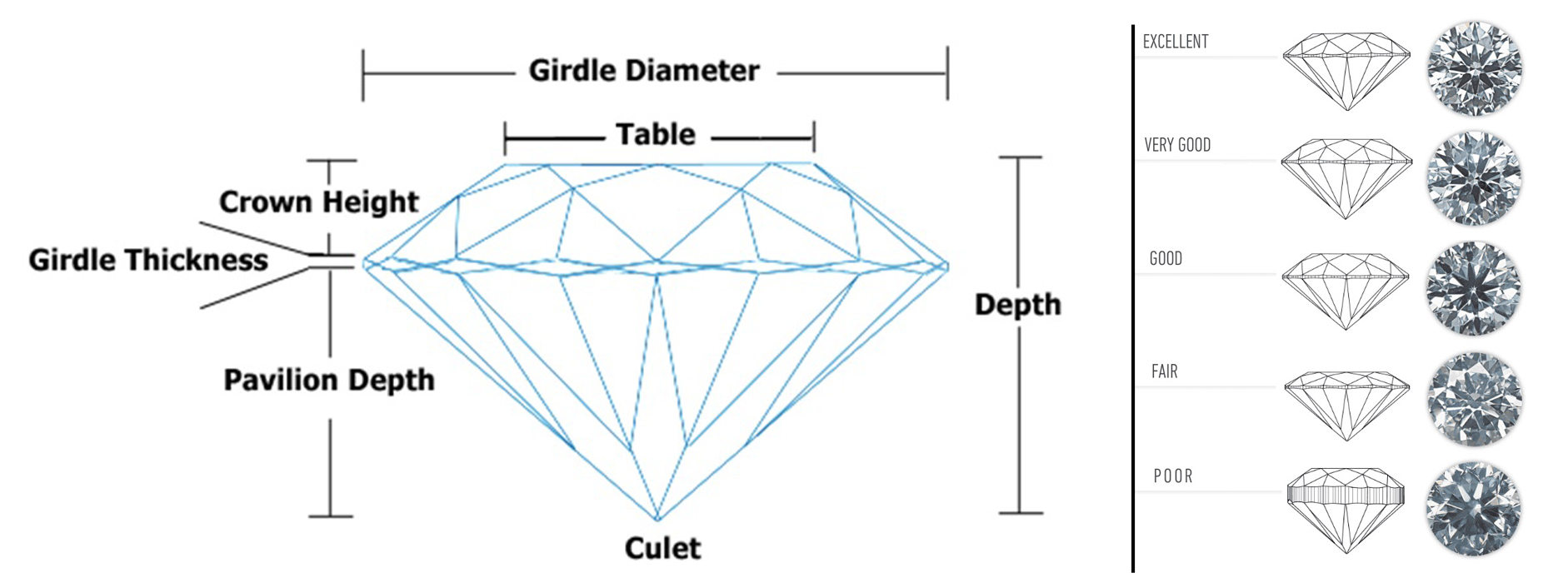
GIA classifies diamond cut quality into five official grades: Poor, Fair, Good, Very Good, and Excellent, consistent with its color and clarity grading systems. Cut evaluation focuses on two core indicators: Polish and Symmetry.
Diamonds graded 3 Excellent (Excellent Cut, Excellent Polish, Excellent Symmetry) on GIA certificates are recognized as high-quality cut diamonds. However, GIA’s tolerance range for cut angles and proportions is relatively lenient. This results in many 3EX graded diamonds failing to display the classic 8 Hearts and 8 Arrows effect.
Therefore, if you pursue ultra-perfect ideal cut diamonds, stricter standards for precise angles, accurate proportions, and standard 8 Hearts and 8 Arrows shapes are required beyond the basic GIA 3EX grading.
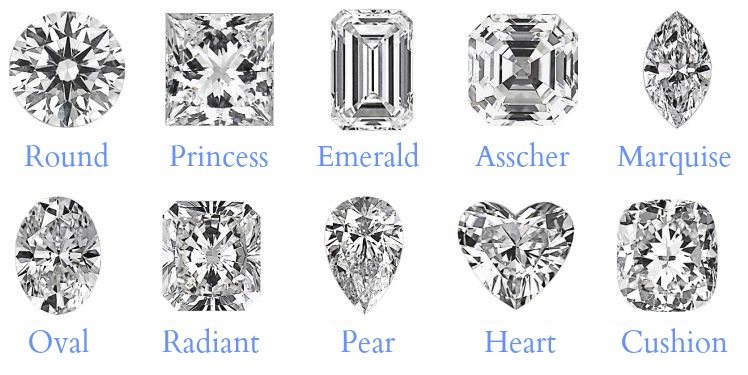
In addition to the classic round brilliant cut, loose diamonds come in various fancy shapes, including Heart Shape Cut, Princess Cut, Pear Shape Cut, and more. We will introduce the characteristics of different diamond cuts in future articles. Stay tuned!
Showing 1 to 4 of 4 (1 Pages)
4 Comment(s)
Lorem Ipsum is simply dummy text of the printing and typesetting industry. Lorem Ipsum has been the industry's standard dummy text ever since the 1500s, when an unknown printer took a galley of type and scrambled it to make a type specimen book.
Lorem Ipsum is simply dummy text of the printing and typesetting industry.
Lorem Ipsum is simply dummy text of the printing and typesetting industry. Lorem Ipsum is simply dummy text of the printing and typesetting industry. Lorem Ipsum has been the industry's standard dummy text ever since the 1500s, when an unknown printer took a galley of type and scrambled it to make a type specimen book. Lorem Ipsum is simply dummy text of the printing and typesetting industry. Lorem Ipsum has been the industry's standard dummy text ever since the 1500s, when an unknown printer took a galley of type and scrambled it to make a type specimen book.
Lorem Ipsum is simply dummy text of the printing and typesetting industry.
Lorem Ipsum is simply dummy text of the printing and typesetting industry. Lorem Ipsum has been the industry's standard dummy text ever since the 1500s, when an unknown printer took a galley of type and scrambled it to make a type specimen book.
Sichuan Sykes Mechanical And Electrical Technology Co., Ltd. is a professional supplier specializing in Atlas Copco air compressor system. We provide brand new Atlas Copco air compressors, air dryers, and original genuine spare parts.
Leave a comment